

In regulated manufacturing, quality is expected. What increasingly separates winners from the rest is speed. Better proposals don’t just meet technical and compliance requirements; they improve win rates. Organizations that can develop, review and refine those proposals faster can respond to more opportunities, submit stronger bids and execute contracts sooner.
Yet many quality and engineering teams are constrained by document collaboration tools that were never designed for regulated, large-scale review. While Quality Management Systems (QMS) govern approved documents, the work that determines proposal quality and competitiveness happens much earlier during collaborative drafting, where speed and control often break down.

Control the entire document lifecycle
Our guide will help you gain complete control of your documents from first draft to final archive and build a secure, centralized, single source of truth.
Operational friction, not expertise, is what slows most teams down
Regulated manufacturers are not short on subject-matter expertise. Engineering, quality, compliance, operations and commercial teams all contribute critical insight during bid and proposal development. The challenge is coordinating that expertise efficiently.
Research from McKinsey shows that professionals engaged in complex, information-intensive work spend a significant portion of their time managing emails and documents rather than advancing core objectives. This drag on productivity directly impacts execution speed.
In competitive bid environments, this friction does more than slow teams down. It reduces how many opportunities they can realistically pursue.
Slow document collaboration quietly undermines proposal performance
Many regulated manufacturers still rely on SharePoint, email and Word Track Changes to manage proposal reviews. These tools were built for basic file sharing and light editing, not concurrent collaboration across dozens of contributors.
SharePoint restricts participation
Concurrent user limits force staggered reviews, delaying input from key subject-matter experts and slowing momentum.
Email creates consolidation bottlenecks
Feedback arrives across attachments and threads, requiring manual reconciliation that consumes valuable time and increases the risk of missed or conflicting input.
Track Changes breaks down at scale
Designed for small, sequential edits, it struggles when many reviewers contribute simultaneously. The result is rework and unresolved comments.
The cost is not just inefficiency. Every extended review cycle reduces proposal throughput and weakens competitive positioning.
Collaboration risks tend to follow predictable patterns in regulated manufacturing
When regulated documents are reviewed using general-purpose tools, predictable collaboration risks slow teams down and weaken outcomes. These risks compound delays and increase rework.
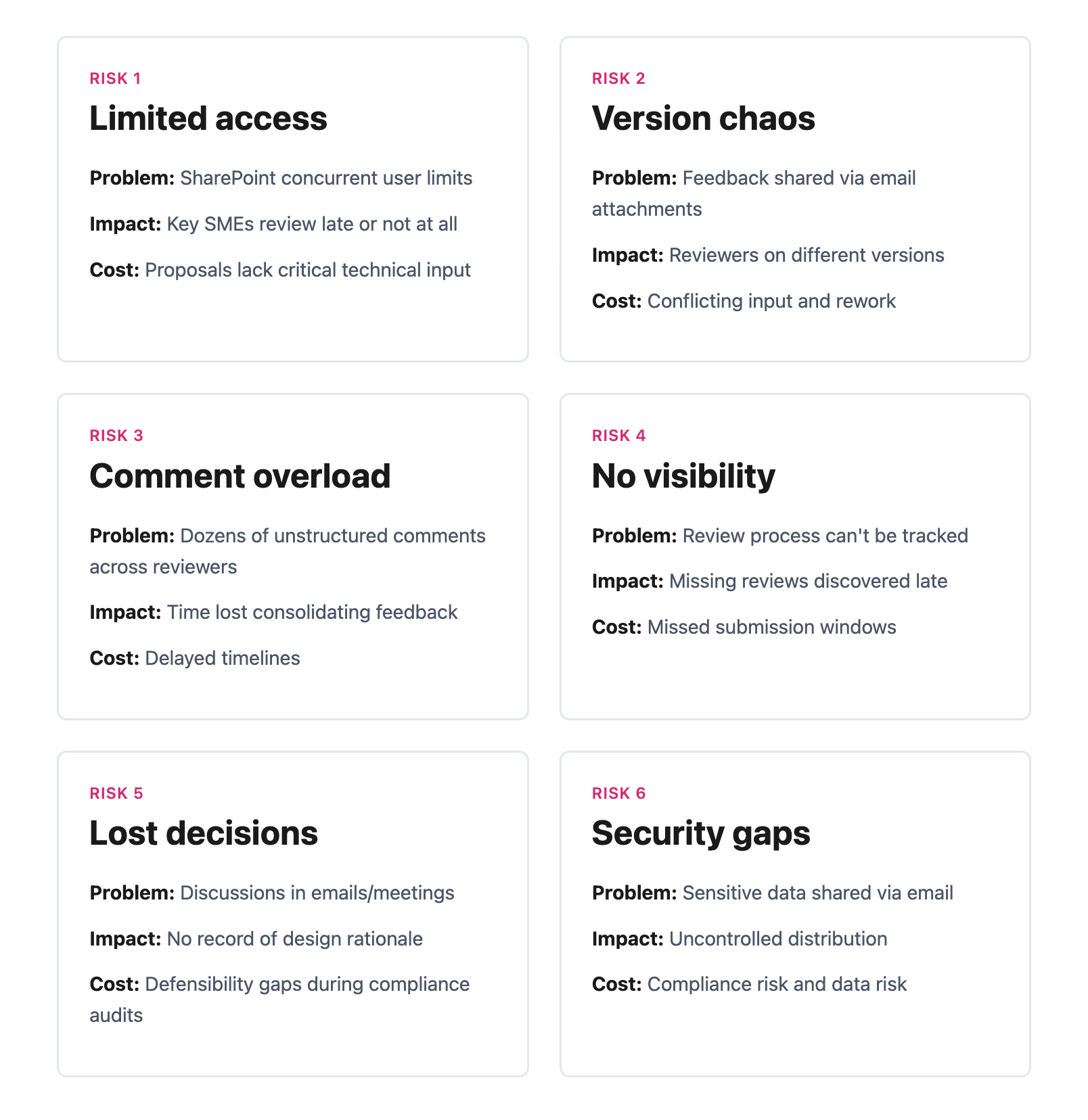
These risks become especially visible during proposal and bid development. Engineering, quality, compliance and commercial teams must align quickly under deadline pressure. When collaboration tools dictate pace, review speed is limited by process constraints rather than team availability.
Faster reviews lead directly to better outcomes
When collaboration bottlenecks are removed, regulated manufacturers do more than work faster. They compete more effectively.
Document review software designed for regulated environments enables secure, concurrent collaboration at scale. Review cycles shrink from days to minutes, freeing teams to respond faster and pursue more opportunities using the same resources.
That reduction in opportunity cost is critical. Faster reviews enable:
- More bids submitted per quarter
- Broader SME input without delays
- Stronger proposals and higher win rates
- Faster execution after contract award
Organizations using Ideagen document collaboration tools see these gains realized in real-world use:
BAE Systems reduced document review cycles from 24 hours to 30 minutes by enabling unlimited concurrent collaboration and replacing sequential reviews with real-time input.
International Energy Agency (IEA)
“We receive about 1,200 comments for the draft report, and Ideagen Please Review lets us see all the consolidated comments in less than a minute. We save a lot of time.”
Navy Warfare Development Center (NWDC):
“The workflow is simpler and real-time. Our goal was to make the document review process faster for the warfighter, and PleaseReview has done exactly that.”
"I am 100% delighted with Please Review. It has freed me from days of comment incorporation and playing referee!"
These gains are not about cutting corners. They come from removing friction that never add value.
Complete document lifecycle control enables speed without compromise
Quality Management Systems play a critical role in governing approved records, including version history, approvals and distribution. They do not control the collaborative development phase where content quality, speed and competitiveness are determined.
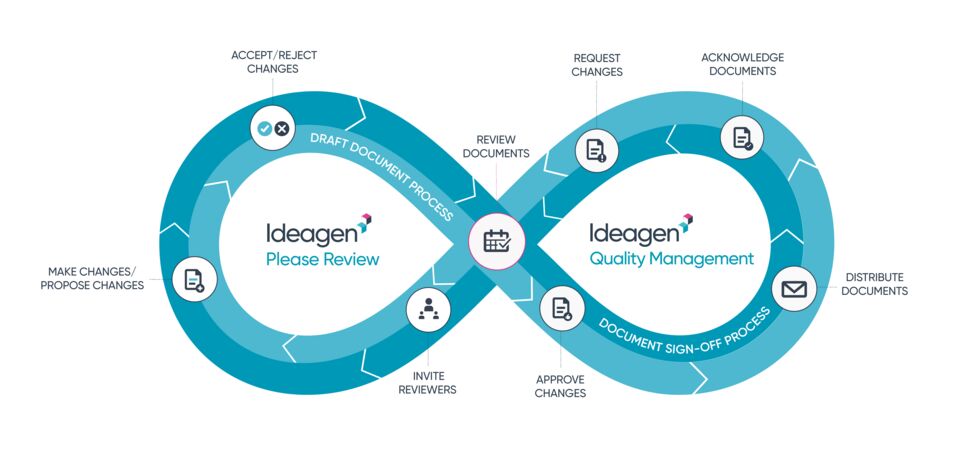
Document review software fills this gap by governing how documents are created, reviewed and refined before approval.
- All stakeholders collaborate concurrently
- A single controlled version eliminates rework
- Full audit trails preserve rationale and compliance
- Traceability flows seamlessly into the QMS
Together, document review and QMS deliver complete document lifecycle control, enabling regulated manufacturers to move faster without sacrificing quality or oversight.
Winning more work starts with controlling collaboration
In regulated manufacturing, quality will always matter. Increasingly, the ability to collaborate quickly and effectively determines who wins contracts and executes first.
Organizations that extend control into the collaborative development phase do more than improve efficiency. They expand capacity, increase win rates and accelerate outcomes.
When teams control the entire document lifecycle from collaboration through approval, speed becomes a competitive advantage rather than a constraint.
Learn how Ideagen quality management and document collaboration solutions provide complete document lifecycle control from collaboration through approval.
Download now
Explore document review solutions
Accelerate your review process with a secure solution designed for real-time collaboration, co-authoring and redaction.
Control the entire document lifecycle
Our guide will help you gain complete control of your documents from first draft to final archive and build a secure, centralized, single source of truth.