

Clinical trial success rates are under increasing pressure. Fewer than 15% of compounds make it from Phase I to approval, reflecting the growing scientific, regulatory and operational complexity of drug development. While scientific uncertainty is unavoidable, execution gaps continue to erode already narrow odds.
One frequently overlooked contributor is document content quality during development. Protocol ambiguities, missing submission details and inconsistent documentation rarely originate during final approvals. They emerge much earlier—during collaborative drafting across Regulatory Affairs, Clinical Research, Medical Writing and external partners. When this phase lacks control, even the strongest Quality Management Systems (QMS) cannot prevent downstream risk.

Control the entire document lifecycle
Our guide will help you gain complete control of your documents from first draft to final archive and build a secure, centralized, single source of truth.
The operational factors behind declining clinical trial success
Clinical trial outcomes are shaped by science, regulation and execution. While scientific risk cannot be eliminated, many delays and failures stem from operational breakdowns—particularly in how critical documents are developed, reviewed and finalized across large, cross-functional teams.
The sections below focus on where document content quality breaks down during collaboration, why traditional tools introduce risk and how controlled document review improves both quality and speed.
The hidden cost of poor document content quality
Life sciences organizations often assume document risk is controlled once content enters formal QMS workflows. In reality, many of the most expensive failures originate earlier—during collaborative drafting, when teams rely on general-purpose tools not designed for regulated content.
SharePoint and email fragment critical submission feedback
When submissions are built across SharePoint folders and email threads, feedback becomes scattered across versions and conversations. Reviewer comments are missed, duplicated or never incorporated, delaying approvals not by weeks, but by months.
Track Changes breaks down at protocol scale
Clinical protocols routinely involve 20–50 contributors across Regulatory Affairs, Clinical Operations, Medical Writing, Biostatistics and CROs. Word’s Track Changes was built for small, sequential reviews—not large, concurrent collaboration. Conflicting edits, unresolved comments and inconsistencies persist, often surfacing only after trials begin, when fixes are dramatically more expensive.
Disconnected tools weaken regulatory narratives
When protocols, statistical analysis plans and clinical study reports are reviewed in isolation—across different tools and repositories—critical linkages are lost. Regulators spot these gaps immediately, triggering information requests and avoidable delays.
Uncontrolled collaboration signals operational risk
Repeated rework, missed feedback and version confusion are often misattributed to weak quality systems. In reality, sponsors and regulators see something else: reliance on consumer collaboration tools for high-stakes, regulated content—an indicator of immature operational control.
The common thread
Across all of these scenarios, the risks do not originate in the Quality Management System. They originate in the collaborative content development phase that precedes approval—the phase where many organizations still rely on email, SharePoint and Track Changes to manage work that directly determines regulatory outcomes.
Where document content quality breaks down during collaboration
When life sciences teams develop regulated documents using tools like SharePoint, email and Word Track Changes, the same risks recur—beginning with collaboration friction and escalating into delays, regulatory exposure and compliance risk.
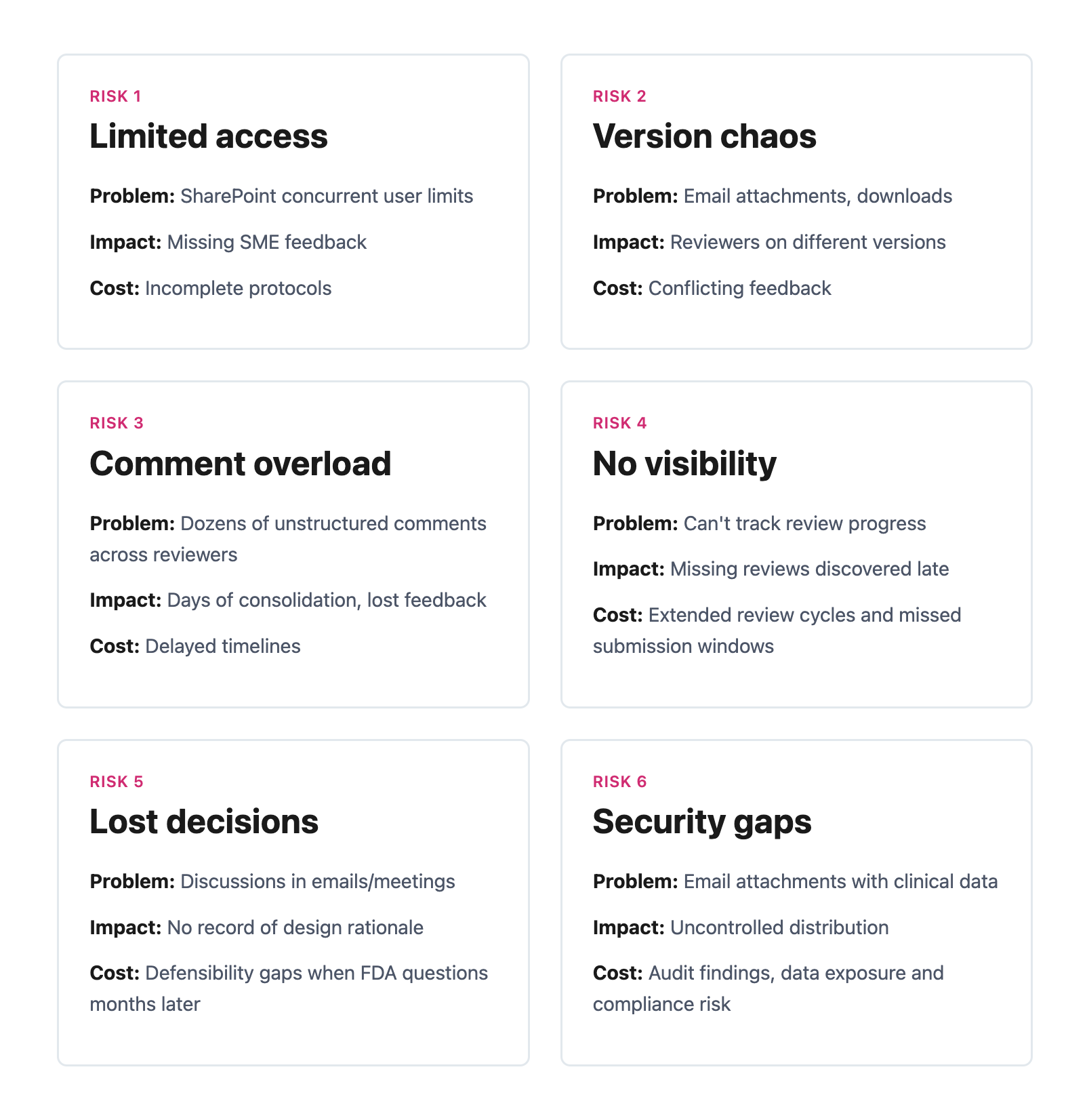
Clinical protocol development illustrates how easily control gaps emerge. A single protocol requires coordinated input from Clinical Research, Regulatory Affairs, Medical Affairs, Biostatistics, Safety, Medical Writing and external CROs.
When this collaboration relies on traditional tools, predictable risks appear: limited visibility into review progress, fragmented feedback, version conflicts and unresolved disagreements that surface too late. Each of these risks directly impacts protocol content quality—and every one is preventable with controlled document review.
How document review software minimizes risk during development
Document review software introduces control at the point where document quality is actually established: during collaborative drafting. Instead of relying on disconnected tools and manual consolidation, teams work within a single, controlled environment designed for concurrent, regulated collaboration.
By maintaining visibility and traceability throughout development, organizations reduce risk before documents ever enter formal approval workflows—when fixes are fastest, least disruptive and most cost-effective.
Key controls include:
Real-time review visibility: See who has reviewed, what’s unresolved and where input is missing—before issues surface late.
Unlimited concurrent collaboration: All stakeholders review simultaneously, removing sequential bottlenecks imposed by traditional tools.
Single, controlled source of truth: Everyone works on the same version, eliminating version conflicts and misplaced feedback.
Automatic audit trails: Every comment, decision and discussion is captured to preserve rationale and regulatory defensibility.
QMS-connected traceability: Content remains traceable from draft through approval, extending control across the full document lifecycle.
Together, these controls produce documents that are more complete, defensible and submission-ready the first time.
"The [document collaboration] integration maximizes our investment by automating version control and ensuring compliance, saving us countless hours and giving us confidence in every review."
Faster development cycles and measurable ROI
Controlled collaboration doesn't just reduce risk—it accelerates timelines by removing the most common review bottlenecks.
Real-time discussion prevents rework. When reviewers can see and resolve issues during the review period, conflicts are addressed immediately instead of surfacing during consolidation—reducing additional review rounds.
Zero comment consolidation delivers immediate time savings. Medical writing teams often spend two to four days per protocol manually consolidating feedback. Document review software eliminates this step by managing proposed changes in-system. As a medical writing manager at Lexicon Pharmaceuticals noted:
I am 100% delighted with PleaseReview. It has freed me from days of comment incorporation and playing referee!
Parallel review eliminates sequential delays. Traditional tools force reviews to happen in sequence—Clinical Research first, then Regulatory Affairs, then Medical Affairs. Document review software enables all stakeholders to work simultaneously, collapsing timelines previously dictated by tool limitations rather than availability.
Early conflict resolution prevents additional review cycles. When reviewers can see each other's comments in threaded discussions, contradictory requirements are resolved during review instead of discovered afterward, avoiding costly rework.
The impact is significant. Research from Tufts CSDD shows that 76% of clinical trials now require protocol amendments, up from 57% in 2015, at a cost of $141,000 to $535,000 per amendment. Nearly half of these amendments are avoidable, stemming from issues that could have been caught during collaborative drafting. Controlling content quality early prevents design flaws that trigger costly downstream corrections.
Complete document lifecycle control for life sciences
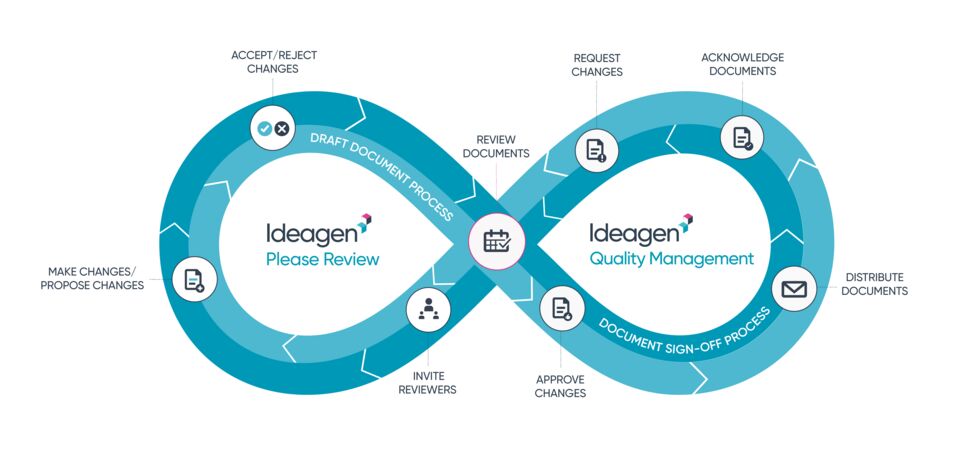
Mature quality organizations recognize that controlling document records—version history, approvals and distribution—is necessary but insufficient. True control requires managing document content during the collaborative development phase where quality is established.
Document review software governs content during drafting. Quality Management Systems govern records after approval. Together, they provide complete document lifecycle control.
The path forward: controlling content quality, not just document records
Quality Management Systems are essential for governing approved documents, but content quality is determined much earlier—during collaborative development. By extending control into this phase with document review software, life sciences teams gain visibility, traceability and audit readiness while working concurrently across functions.
The result is tangible: clearer protocols, stronger first-time submissions and fewer downstream delays. When organizations control content quality during development—not just document records after approval—they improve the likelihood of progressing from Phase I through approval while protecting both patient safety and organizational investment.
Download the guide
Learn how Ideagen quality management and document collaboration solutions provide complete document lifecycle control—from collaboration through approval.
Explore document review solutions
Accelerate your review process with a secure solution designed for real-time collaboration, co-authoring and redaction.
Control the entire document lifecycle
Our guide will help you gain complete control of your documents from first draft to final archive and build a secure, centralized, single source of truth.