
I just returned from the ASQ Lean Six Sigma Conference, and I have to say I left energized, a little surprised and more convinced than ever that our industry is standing at a genuinely pivotal moment.
The room was ready for a real conversation
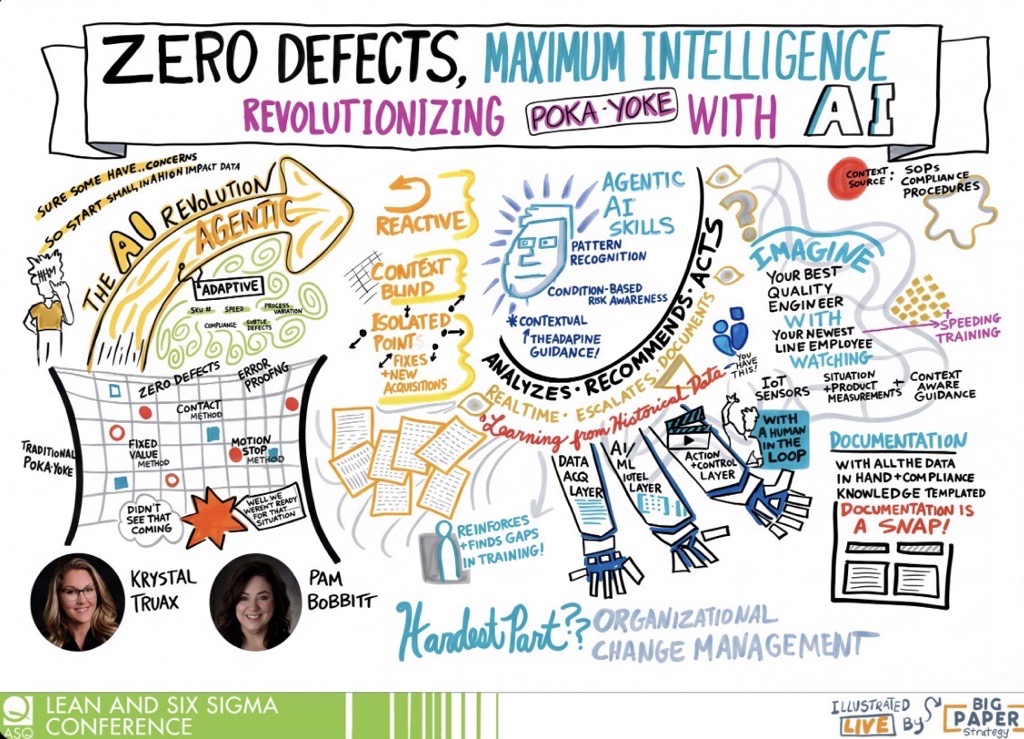
Our session, "Zero Defects, Maximum Intelligence: Revolutionizing Poka-Yoke with AI," was packed and the engagement was electric. What made it special wasn't just the content; it was the live illustration woven throughout the presentation. Watching concepts come to life in real time sparked a level of conversation that you just don't get from static slides. Questions flew. People stayed after. That's the kind of interaction that reminds you why in-person events still matter.
GenAI vs. agentic AI: The distinction that changes everything
One of the most common and important conversations I had throughout the conference was around the difference between generative AI and agentic AI. Most quality and operations professionals have heard something about AI, but the distinction between a tool that generates content and one that actually reasons, decides, and acts within a workflow? That was new ground for many.
Generative AI responds. Agentic AI acts. And for quality professionals thinking about error-proofing, risk assessment and continuous improvement, that difference isn't just semantic — it's the difference between a smarter search engine and a true operational partner.
The real surprise: How many paper processes are still out there
Here's what I didn't fully anticipate: how many organizations I spoke with are still running core quality and safety processes on paper. Inspection forms. Deviation logs. Corrective action tracking. On. Paper.
That's not a criticism, it's a reality check. And it leads to one of the most important distinctions I want to leave with anyone reading this:
Digitization is not the same as digital transformation.
Scanning a paper form and saving it as a PDF? That's digitization. You've created a digital copy of a manual process. The underlying workflow, the decision logic, the bottlenecks — they're all still there, just in a different format.
Digital transformation means reimagining how the process works. It means connecting data across systems, enabling real-time visibility, triggering automated actions and building the kind of structured, accessible data foundation that AI can actually learn from and act on.
Why does this matter? Because if your data is locked in scanned PDFs or siloed spreadsheets, agentic AI can't reach it. You haven't removed the paper problem, you've just moved it. The first step in any intelligent quality or EHS journey isn't AI adoption. It's transformation: getting your processes designed, connected and digitally native.
That's the foundation. Everything else — predictive analytics, autonomous risk detection and AI-driven corrective action — is built on top of it.
What's next: ASQ World Congress in May
The conversations at Lean Six Sigma have me even more excited for what's ahead. I'll be speaking at the ASQ World Congress in May, and I'm looking forward to going deeper on where quality intelligence is headed and what practitioners need to do now to be ready.
If you were at Lean Six Sigma and want to continue the conversation, or if you're planning to be at World Congress, reach out. The dialogue is just getting started.
Explore quality management solutions
Automate and streamline your quality processes, identify opportunities for excellence and achieve compliance with regulations and standards.