



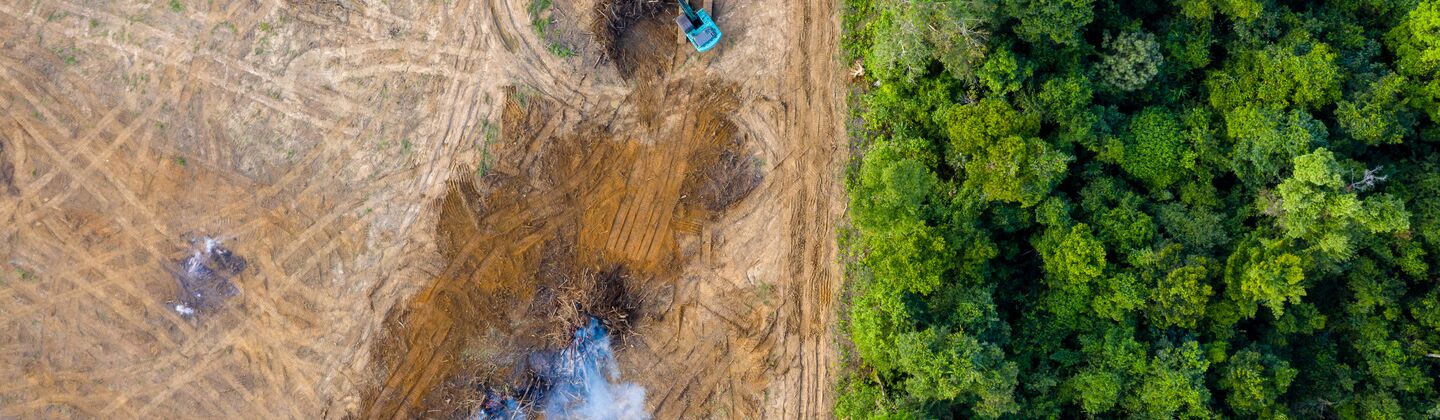
The EU Deforestation Regulation, known as EUDR, requires any business placing certain commodities on the EU market, or exporting them from it, to prove those products did not come from land deforested after December 31, 2020. For food and beverage organizations, that means cocoa, coffee, palm oil, cattle, and soya, along with anything made from them, from chocolate to leather to animal feed.
The regulation becomes mandatory on December 30, 2026 for medium and large operators, and June 30, 2027 for micro and small operators. If your organization sources any of the commodities below, this is the year to get the underlying data in order, not the year the deadline slips again.
Why does EUDR exist?
Agricultural expansion is the single biggest driver of global deforestation, and a large share of the commodities behind it end up in products consumed in the EU. The regulation is the EU's attempt to break that link. Rather than banning imports outright, it shifts the burden of proof onto the businesses placing these products on the market: know where it came from, or don't sell it here.
The European Commission estimates the measures will cut carbon emissions linked to EU consumption of these commodities by at least 32 million tonnes a year. Whatever view you take of the policy, the mechanism is straightforward. No transparency data, no market access.
Which products does EUDR cover?
EUDR applies to seven core commodities and their derived products:
- Cattle, including beef and leather
- Cocoa, including chocolate and cocoa butter
- Coffee, including roasted, instant, and soluble forms
- Palm oil, including a wide range of derivatives used in processed food and cosmetics
- Rubber, including packaging and industrial components
- Soya, including animal feed, which is one of the most commonly missed routes into scope
- Wood, including furniture and paper products
If your organization handles a commodity indirectly, through an ingredient supplier or an animal feed contract, you are still in scope if that commodity reaches the EU market inside your finished product. This catches out more food and beverage businesses than the headline commodity list suggests.
Scope is also still moving. A draft delegated act published alongside the Commission's May 2026 review proposes adding instant and soluble coffee and palm oil derivatives, while potentially removing leather, cattle hides and skins, and product samples. None of this is adopted yet, so treat it as a strong signal rather than a confirmed rule, and revisit your scope assessment once it clears Parliament and Council scrutiny.
What do businesses actually have to prove?
Two things: that the product does not come from land deforested or degraded after December 31, 2020, and that it was produced legally under the laws of the country of origin, including labour and land rights.
To prove it, an operator has to collect geolocation data identifying the specific plot of land the commodity came from, not just a country or region. That data feeds into a due diligence statement, submitted through the EU's Information System before the product goes on the market or gets exported.
Who actually has to submit the paperwork?
Under the current rules, only the operator first placing a commodity on the EU market has to complete the full due diligence statement. Downstream operators, a chocolate manufacturer using cocoa that already has a statement attached to it, for example, can reference that statement rather than duplicating the work.
Micro and small primary operators get an even lighter route: a simplified, one-time declaration instead of a full statement. Enforcement sits with each EU member state's competent authority, and increasingly draws on satellite monitoring to check where products actually came from against what operators declare.
When does this actually start?
The regulation has already been postponed twice, so a healthy amount of scepticism about deadlines is fair. As things stand:
- December 30, 2026 for medium and large operators
- June 30, 2027 for micro and small operators
- December 30, 2026 for micro and small operators already covered by the old EU Timber Regulation
The Commission's May 2026 simplification review confirmed the regulation will not be reopened before these dates. The reporting mechanics have got lighter for many operators since the rules were first drafted, but the underlying requirement, provable, plot-level traceability, has not moved and is not going to.
How should food and beverage businesses prepare?
Start with the data, not the paperwork. Map which of your products contain the seven commodities above, including indirect routes like animal feed. Identify where your geolocation data gaps are, because this is almost always the slowest part of the process, particularly for smallholder-heavy supply chains like cocoa and coffee. Then build a process for collecting due diligence evidence, land tenure documents, legal production proof, and certification status, that doesn't rely on chasing suppliers over email every time a report is due.
This is also where a platform like Ideagen Supply Chain earns its place: mapping suppliers back to source across multiple tiers, with geolocation polygons accurate to six decimal places at supplier and farm level, checking supplier certification against schemes like FSC, RSPO, and RTRS automatically, and giving a live view of deforestation risk by region through a Global Forest Watch overlay. Worth being precise on scope: this maps and de-risks your supplier base thoroughly, which is the essential foundation, but EUDR's plot requirement is ultimately batch-specific, so matching a given shipment to its exact contributing plots is a further step on top of supplier-level mapping, not something supplier-level data alone completes. Doing the supplier side well in one place, rather than across a dozen spreadsheets, is still the difference between being ready in December 2026 rather than collating information from segregated sources.
Ready to see how Ideagen Supply Chain can map commodities in scope back to source? Request a demo with the team.
Frequently asked questions
Does EUDR apply to businesses outside the EU?
Yes. Any business exporting the seven commodities, or derived products, into the EU market is in scope, regardless of where the business itself is based.
What counts as deforestation for EUDR purposes?
Land converted from forest to agricultural use after December 31, 2020. The cut-off date applies regardless of whether the conversion was legal under local law at the time.
Does having FSC or RSPO certification mean a product is automatically compliant?
No. Certification is strong supporting evidence for parts of the due diligence process, but it does not replace the requirement to hold plot-level geolocation data behind the certified claim.
What happens if a business can't provide the required data?
The product cannot legally be placed on the EU market or exported from it. Competent authorities can also apply penalties, which vary by member state.
Is EUDR likely to be delayed again?
The Commission's May 2026 review explicitly ruled out reopening the regulation before the December 2026 and June 2027 deadlines, which is the strongest signal yet that these dates are the ones to plan against.
Explore food & beverage solutions
One contamination event. One missed audit. One gap in your supply chain. That's all it takes to undo years of hard-won consumer trust. One connected platform. Every food and beverage challenge covered.